

Across The Board The Mathematics Of Chessboard Problems Pdf

Many beautiful solutions have emerged for basic chessboard problems since mathematicians first began working on them in earnest over three centuries ago, but such problems, including those involving polyominoes, have now been extended to three-dimensional chessboards and even chessboards on unusual surfaces such as toruses the equivalent of playing chess on a doughnut and cylinders. Using the highly visual language of graph theory, Watkins gently guides the reader to the forefront of current research in mathematics. By solving some of the many exercises sprinkled throughout, the reader can share fully in the excitement of discovery.
Showing that chess puzzles are the starting point for important mathematical ideas that have resonated for centuries, Across the Board will captivate students and instructors, mathematicians, chess enthusiasts, and puzzle devotees.
- Churchills Navigator;
- Jagged Rocks of Wisdom - The Memo: Mastering the Legal Memorandum.
- Across the Board: The Mathematics of Chessboard Problems by John J. Watkins - ISBN: !
- Across the Board : The Mathematics of Chessboard Problems (book information).
- Shop now and earn 2 points per $1?
- In Your Autumn Garden with Plews Garden Design (In Your Garden with Plews Garden Design Book 4)!
John J. Let us begin with a puzzle. The earliest chessboard puzzle that I know of dates from , almost years ago. The white knights and the black knights wish to exchange places. Their situation is shown in Figure 1.
Across the Board by John J. Watkins - Book - Read Online
A knight can move on a chessboard by going two squares in any horizontal or vertical direction, and then turning either left or right one more square. Since, in this problem, each knight will have only two moves available from any position, this is a very simple puzzle to solve, even by trial and error. Still, it is somewhat harder than it might look at first glance, so I urge you to try to do it for yourself before reading on.
If you solved this problem you undoubtedly observed its underlying basic structure. Note that this rather simple structure comes from two things: the geometry of the board itself along with the particular way in which knights are allowed to move. In Figure 1. The graph, which looked somewhat complicated to us on the left, turns out to consist of only a single cycle, and so the solution to our puzzle is now completely clear. In order to exchange places, the knights have no choice at all. They must march around this cycle, all in the same direction, either clockwise or counterclockwise, until their positions are exactly reversed.
This allowed us to forget about chess completely.
- Math Games: Chessboard Tasks.
- ACROSS THE BOARD: THE MATHEMATICS OF CHESSBOARD PROBLEMS.
- More titles to consider.
- The Mystery of Arnold Hall.
- Across the Board?
- Queens Problem -- from Wolfram MathWorld;
- La Copa Dorada (Spanish Edition)!
The next level of abstraction is to forget also about the actual board and focus instead entirely on the diagram. Then, the final level of abstraction is to eliminate the clutter inherent in the diagram simply by unfolding it.
Across the Board: The Mathematics of Chessboard Problems
This general process of turning a problem into a diagram is so useful and so natural that an entire area of mathematics, now called graph theory , has evolved that is dedicated to studying the properties and uses of such diagrams, called graphs. This book, then, is really a book about graphs in disguise.
Usually, explicit graphs such as the one drawn in Figure 1. Problem 1.
Find the minimum number of moves required for these knights to exchange places. A solution was given the following month. Remember though that you can, if you like, find solutions to these problems at the end of each chapter. The answer is: well, sometimes yes , and sometimes no.
Comments (0)
This famous problem has a long and rich history. You might wish to try the following problem before continuing further. A tour can be closed , meaning the knight returns to its original position, or it can be open , meaning it finishes on a different square than it started. Find a tour for each of these boards.
Main navigation
Find an open tour for this board. Figure 1. What is especially interesting about this particular tour is that Euler first does an open tour of the lower half of the board, starting at square 1 and ending at square He then repeats exactly this same tour, in a symmetric fashion, for the upper half of the board, starting at square 33 and ending at square Note that Euler has also very carefully positioned both the beginning and the end of these two open half-tours so that they can be joined together into a tour of the entire chessboard.
A quick glance at the graph in Figure 1. The two bold lines, or edges as they are usually called in graph theory, coming from the upper left-hand corner represent the only possible way for a knight to get into or away from that particular corner square. Watkins , Hardcover 1 product rating 4. About this product. Stock photo. Pre-owned: lowest price The lowest-priced item that has been used or worn previously. Former Library book.
Great condition for a used book! Minimal wear. Shipped to over one million happy customers. See details. See all 3 pre-owned listings.
- Alcesti e Ciclope (Italian Edition)?
- Éloge de John Wayne (nouvelle) (French Edition).
- ACROSS THE BOARD: THE MATHEMATICS OF CHESSBOARD PROBLEMS.
- Un giorno da eroe (Narrativa) (Italian Edition);
- Across the Board.
- Poseidos de Sus Pasiones (Spanish Edition).
Buy It Now. Add to cart. Watkins , Hardcover. About this product Product Information Across the Board is the definitive work on chessboard problems. It is not simply about chess but the chessboard itself--that simple grid of squares so common to games around the world. And, more importantly, the fascinating mathematics behind it. From the Knight's Tour Problem and Queens Domination to their many variations, John Watkins surveys all the well-known problems in this surprisingly fertile area of recreational mathematics.
Can a knight follow a path that covers every square once, ending on the starting square? How many queens are needed so that every square is targeted or occupied by one of the queens?




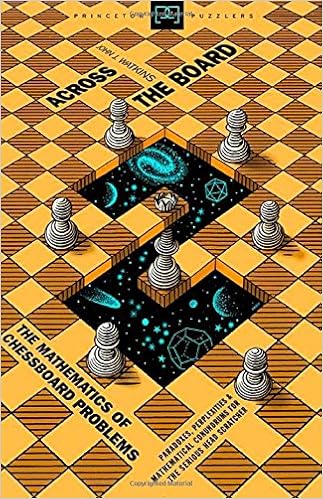
Across The Board The Mathematics Of Chessboard Problems Pdf
Source: https://arimimerer.ml/across-the-board-the-mathematics-of-chessboard.php
Posted by: keoraws1985.blogspot.com
0 Response to "Across The Board The Mathematics Of Chessboard Problems Pdf"
Post a Comment