

How To Draw Cross Section Of Aquifer
Creating Aquifer Sections (Multi-Console)
RockWorks | Borehole Managing director | Aquifers | Section
Use this program to:
- Interpolate grid models for the upper and lower surfaces of a single aquifer or multiple aquifers listed for a item date or date range in the Water Levels table, and
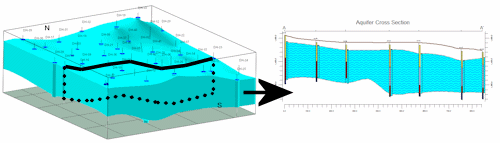
- "Slice" these grid models along whatever path and create a second cross department diagram comprised of multiple panels. Considering surfaces are interpolated across the entire project, you tin identify the section panels anywhere you like.
Numerous surface modeling options are offered. The section tin be colour- or pattern-filled, and logs tin exist appended. The completed department volition be displayed in RockPlot2D. Multiple aquifers are supported.
See also: Modeled Aquifer Profiles for grid-based cross sections with single slices.
Feature Level: RockWorks Standard and higher
Menu Options
Stride-by-Step Summary
Tips
Menu Options
- Choose Aquifer(south): Aggrandize this heading to select which aquifers are to be represented in the cantankerous section.
- All Aquifers: Choose this pick if surfaces for all defined aquifers are to be created.
- Single Aquifer: Choose this choice if you lot wish to model a single aquifer only.
- Aquifer: Click to the right to select the name of the aquifer you wish to model at this time. The names that are displayed are read from the electric current Aquifer Types Table. This table as well defines the colour and pattern to be used to stand for each aquifer.
- Aquifer: Click to the right to select the name of the aquifer you wish to model at this time. The names that are displayed are read from the electric current Aquifer Types Table. This table as well defines the colour and pattern to be used to stand for each aquifer.
- Engagement / Time Filtering: Utilise this checkbox along the right side of the options window to select the individual engagement or appointment range for the data to be processed.
- Cull Verbal to enter the engagement for which the information is to be processed. The date you lot enter here should match the date you entered into the H2o Levels data tables.
- Click in the Range push button if yous desire to procedure water level information for a range of dates, and and so specify the starting and catastrophe engagement and/or time for the data to be included in processing. (See Entering Water Level Data for details near how the dates are entered.)
! If y'all have multiple entries for a borehole for the selected appointment range, the plan volition include all of them when interpolating the surfaces, in effect averaging them.
- Surface Modeling: Expand this heading to establish the options for creating the upper and lower surface models.
- Gridding Options: Click on this button to admission a window where you can establish the gridding method (aka algorithm), the grid dimensions, and other gridding options which volition be used to interpolate the aquifer surface models.
- Algorithms: Select a gridding method from the list on the left, and establish the method-specific Options in the middle pane.
- Grid Dimensions: Specify how the filigree dimensions are to be established, using the settings on the correct side of the dialog box. Unless there's a specific reason to do otherwise, yous should probably leave the grid dimensions gear up to the current output dimensions.
- Additional options: Establish the other general gridding options (declustering, logarithmic, loftier fidelity, etc.).
- Gridding Options: Click on this button to admission a window where you can establish the gridding method (aka algorithm), the grid dimensions, and other gridding options which volition be used to interpolate the aquifer surface models.
- Aquifer Fable: Insert a cheque here to include a list of the aquifer names along with their represented patterns/colors in the department diagram. Expand this detail to plant the legend settings. (More.)
- Plot Logs: If y'all would like for the program to append striplogs to your cantankerous section, insert a check hither.
! Annotation : If you don't draw your modeled department from borehole to borehole (for these sections, information technology'south non required that the endpoints coincide with borehole locations), AND if you lot plot the logs, the program volition be forced to choose the closest borehole to identify at the section panel edges.
! Annotation : Deviated/inclined boreholes will be plotted as vertical because of the impossibility of projecting them onto different planes at angled console junctions. This may result in a visual mismatch between the interpolated surfaces and the observed logs. -
- Clip Logs: Check this sub-detail if you desire to restrict the logs to a particular elevation range.
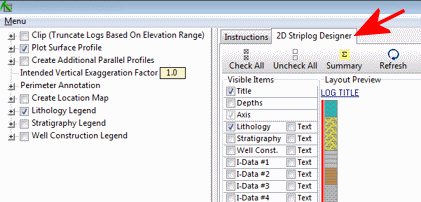
- 2D Striplog Designer: Click on the second Striplog Designer tab to the right, to select the items to display in the individual logs to overlay the aquifer section.
-
-
- Visible Items: Use the check-boxes in the Visible Items column to select which log items are to be displayed. Run across Visible Item Summary for information about the unlike log items.
- Options: Click on whatsoever of the Visible Items names to see the item's settings in the Options pane to the correct. See the Visible Item Summary, for links to the Options settings.
- Layout Preview: For each item you've activated, you'll meet a preview cartoon in the upper pane. Click and drag any particular to the left or right to rearrange the log columns. Meet Using the 2d Log Designer.
-
- Plot Surface Contour: Insert a bank check hither to include a line on the cross section that represents a user-selected filigree model, typically the ground surface. Expand this heading to admission the line contour options.
- Surface Profile Options: Click the Options push button to select the filigree model to be represented, and to establish the profile settings. (More than.)

- Prove Error(s): Cheque this box to brandish vertical fault lines in the cross section, based on the location of one or more fault polylines defined in the project database. (More than.)

- Show Infrastructure: Check this box to display buildings, pipes, or other infrastructure with your cantankerous department. Click the Options button to define the infrastructure file and plot settings. (More than.)
-

- Perimeter Annotation Options: Click on this push to establish vertical exaggeration, title, and border settings for the cross department. (More.)
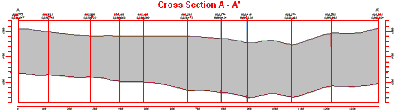
- Create Location Map: Insert a cheque here to have the programme create, along with the cross-department, a reference map that shows the section trace'south location. It can be embedded in or created separately from the cantankerous-department. (More.)
-
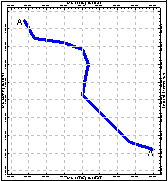
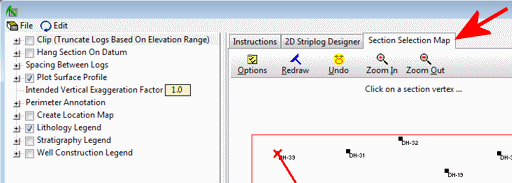
Section Selection Map: Click on the Department Option Map tab to the right, to draw where the cross section panels are to exist placed. The near contempo section fatigued for this project will exist displayed. (More than.)
Step-by-Step Summary
Follow these steps to create a 2-dimensional (flat) multi-console section of 1 or more aquifers, based on modeled surfaces:
- Admission the Borehole Managing director program tab.
- Enter/import your data into the Borehole Manager. This tool specifically reads location, orientation (if any), and h2o level data.
- Enable boreholes: Be sure that all boreholes whose data are to be included in the aquifer model, which volition be sliced for the cantankerous-section, are enabled.
- Select the Aquifers | Section command.
- Enter the requested menu items, described above
- Fix logs: If you are including logs with the section, be sure to click on the 2D Striplog Designer tab to establish how you desire the logs to look. (More.)
- Option the section: Click on the Department Pick Map tab to constitute the section location. (More.)
- Click on the Procedure push button to create the diagram.
- If you accept activated the gridding Dimensions / Confirm Dimensions selection, the programme will display a summary window with the grid boundary coordinates and node spacing. Adjust these items if necessary and click OK. More.
The programme will use the selected gridding algorithm to create grid models of the surface, base of operations, and thickness of the selected aquifer(due south), storing the models on disk ("aquifername_date_top.RwGrd", "aquifername_date_base.RwGrd" and "aquifername_date_isopach.RwGrd"). The name portion of the file name will be pulled from the Aquifer Types table, and the engagement portion of the file proper name should comply with the mm_dd_yyyy or dd_mm_yyyy engagement format as established in Windows.
It volition then expect at the coordinates specified for the section panels and determine the closest nodes along the cut in each grid model. It will construct a vertical profile for each panel to illustrate the water level elevations, using the colors and/or patterns divers for the section. The panels will and so be appended together to create the multi-panel section. If requested, it will annotate the edge with tick marks and centrality labels. If you have requested strip logs, they volition be appended to the section diagram. The completed diagram will exist displayed in a RockPlot2D tab in the Options window.
- You can accommodate any of the following items so click the Process push once again to regenerate the section.
- Aquifer model settings in the Options pane on the left*, and/or
- Diagram settings in the Options pane on the left, and/or
- Striplog settings in the 2d Striplog Designer tab, and/or
- Department location in the Section Selection Map tab.
! Each time you click the Process button, the existing brandish will be replaced.
- View / save / manipulate / print / export the diagram in the RockPlot2D window.
Tips : Utilize the Stretch button  in RockPlot to fill the window with the department. This is helpful if the section is long and shallow.
 Back to Aquifers Menu Summary

RockWare dwelling house page

Source: https://help.rockware.com/rockworks17/WebHelp/aq_section.htm
Posted by: keoraws1985.blogspot.com
0 Response to "How To Draw Cross Section Of Aquifer"
Post a Comment